Real Estate
Eviction of an Occupant Without Right or Title in Morocco
Quick answer
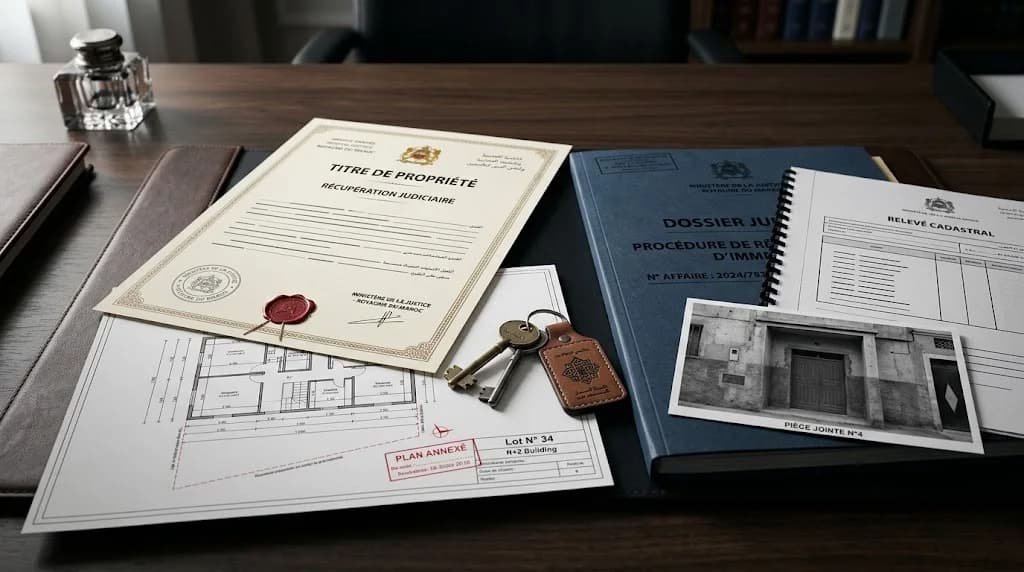
In Morocco, an owner or other right-holder can ask a court to recover immovable property from a person occupying it without any legal right or title (occupation sans droit ni titre / الاحتلال بدون سند). The action rests on the claimant's real right under the Code des droits réels (Law 39-08) and is run through the current Civil Procedure Code (Law 58.25). The claimant must establish the legal position relied upon, identify the exact property, and prove the material occupation; standing to sue is analytically distinct from ultimately proving ownership. An occupant is not automatically "without title" merely because the claimant says so: a lease, a permission, a co-owner's authorization, an inheritance or a sale, once seriously raised, can require a determination on the merits. Where the occupation is manifestly without title and there is no serious dispute, eviction may be sought before the urgent/interim judge (juge des référés); where ownership, a lease or another right is seriously contested, the merits court resolves it. Precisely identifying the occupied property matters, and a mismatch between the property claimed and the property actually occupied can defeat the action; judicial expertise and a bailiff's constat are often used. The claimant may seek an occupation indemnity, but this guide states no figures or formulas. Obtaining an eviction judgment is not the same as completing enforcement, and a claimant must not resort to force, lock-changes or utility cut-offs. This guide is national, balanced and informational, and does not replace tailored advice.
A national, balanced and informational guide to the eviction of an occupant without right or title in Morocco: what the claimant must establish, the distinction between standing and proof of ownership, identifying the exact property, the occupant's possible defences (lease, permission, co-ownership and other rights), when eviction can be sought before the urgent judge and when a serious dispute sends it to the merits court, occupation indemnity, enforcement, and why self-help is unlawful.
Eviction of an occupant without right or title in Morocco, in short
When someone occupies a building or a plot in Morocco without a lease and without any legal title, the owner or right-holder cannot simply take the property back by force. The law provides a judicial route: an action to recover the property from an occupant without right or title (occupation sans droit ni titre; in Arabic, الاحتلال بدون سند, and the action is often called إفراغ المحتل — sometimes طرد المحتل).
The claimant has to establish the legal position relied upon, identify the exact property, and prove the material occupation. The occupant, in turn, may raise a lease, a permission, a co-owner's authorization, an inheritance or another right — and where that challenge is serious, it can move the dispute from a summary track to a full determination on the merits.
This guide is national, balanced and informational. It explains the framework in substance, without pinning exact article numbers, deadlines or amounts that should be confirmed against the current text for a specific file, and it is written for both the party seeking recovery and the occupant who may have a genuine right.
What occupation without right or title means
"Occupation without right or title" describes the actual physical occupation of immovable property by a person who has no legal basis — no lease, no permission, no ownership or other real right — justifying that occupation. It is the absence of a legal title to occupy, combined with real material occupation, that characterises the situation.
The English word "squatter" can be misleading here, because it suggests a settled factual category rather than a legal conclusion. In Moroccan practice the question is legal: does this occupant hold, or can this occupant show, a right that justifies remaining? Calling someone an occupant "without title" is the claimant's assertion, not an established fact, until the position is examined.
That is why the action is not a formality. It turns on the claimant's right, the identity of the property, the reality of the occupation, and whether the occupant can point to a genuine legal basis for staying.
The current Moroccan legal framework
The action rests, in substance, on the claimant's real right over the property. Ownership and other real rights are governed by the Code des droits réels (Law 39-08), from which the owner's ability to enjoy the property and to recover it from a person occupying it without any right is derived. The right of property is also protected at the constitutional level, but that protection is context, not the operative cause of the action.
Procedurally, the action is run through the current Moroccan Civil Procedure Code (Law 58.25), which governs the urgent/interim jurisdiction, the merits proceedings, service, appeal and enforcement. This guide describes that procedure in substance and does not pin article numbers, which should be verified against the text in force; the former 1974 Code of Civil Procedure no longer states the current rules and should not be relied on.
Where the occupant invokes a contract, the Dahir des obligations et contrats (DOC) is relevant to proof and to the effect of that contract, and the lease statutes (Law 67-12 for residential and professional leases, Law 49-16 for commercial leases) matter only at the boundary — to decide whether the occupier is really a tenant rather than an occupant without title.
What the claimant must establish
In broad terms, the claimant has to show three things: the legal position or right relied upon; that the property is precisely identified; and that the defendant materially occupies it. These are cumulative — a strong title over the wrong parcel, or a clear right with no proof of occupation, will not carry the action.
Beyond that, the analysis turns on whether the occupant can point to a legal title or right justifying continued occupation, and whether any such claim raises a serious dispute. The action is not reducible to "the owner shows a title and the occupier leaves": each element can be contested, and the route (urgent or merits) depends on how genuinely the underlying right is in issue.
For the occupant, the mirror is equally practical: identifying which element is weakest — the claimant's right, the identity of the property, the proof of occupation, or the absence of a title — is where a defence is built.
Who can bring the action: standing vs proof of ownership
A recurring confusion is between standing to sue and proof of ownership. They are analytically distinct. A claimant has standing when they act as the holder of the right relied upon — for example an owner, a co-owner, a holder of another real right, or a person whose legal position over the property is recognised — independently of whether, at the end, full ownership is proven.
This matters because a defendant sometimes argues that the claimant "has not proven ownership" as though that defeated the right to sue. The quality to bring the action and the ultimate question of who owns the property are not the same thing, and treating them as identical misstates the analysis.
It also means the claimant should be clear, from the outset, about which right is being asserted, because that choice shapes what has to be proven and whether the matter can be handled summarily or must go to the merits.
Proving the claimant's right or legal position
For registered property, the land register and the title certificate are usually powerful evidence of the right asserted, because the register records who holds the recognised rights over the property. For unregistered property, the proof is more fact-intensive and may rest on acquisition documents, inheritance, prior transactions or judgments, and possession.
It should not be assumed that a registered land title is universally mandatory in every configuration, nor that producing a certificate automatically ends the matter. The right relied upon has to fit the property occupied and the situation in dispute, and a competing claim may still require examination.
The practical task is to assemble the documents that actually support the specific right invoked — and to make sure they correspond to the property the occupant is on, which is the subject of a later section.
Proving material occupation
The action concerns real, physical occupation of the identified property, so the claimant has to show that the defendant actually occupies it. Evidence commonly used includes a bailiff's constat, photographs, correspondence, utility or delivery records, and, where the facts are contested, judicial expertise.
No single item is automatically decisive. Photographs alone may not establish who occupies, for how long, or exactly which premises; a constat is a standard and persuasive tool but is not, in every case, a legal precondition. The weight of each piece of evidence depends on what it actually shows.
The aim is a coherent picture: that this defendant occupies this property, now, without a legal basis — not merely that the property is occupied by someone at some time.
What can constitute a title or right to occupy
A person is not an occupant without title simply because the claimant says so. A range of legal bases can justify occupation: a written or oral lease, a permission or authorization, a loan for use, a co-owner's consent, an employment or management arrangement, a usufruct, ownership or co-ownership, inheritance rights, or a sale or other transaction.
The existence, validity, scope and termination of any such right are what the analysis turns on. A claimed right that is genuine and still in force defeats the "without title" characterisation; one that never existed, or has been properly brought to an end, does not.
The point for both sides is that the label is a legal conclusion to be tested, not a starting assumption. Not every alleged right will hold — but not every occupant is titleless either.
The lease boundary: written and oral leases
An effective lease is not the same thing as occupation without title. Where a genuine tenancy governs the occupation, the occupier is a tenant, and the relationship generally has to be properly ended under the applicable lease regime before that person can be treated as having no continuing title. For a commercial lease specifically, the dispute may belong to the commercial-lease regime rather than to occupation-without-title doctrine, which is addressed in the guide to commercial-lease eviction and indemnity in Morocco.
This guide does not set out the full residential or commercial lease-termination procedure. The point at the boundary is that a tenant is not converted into an occupant without title merely because the claimant wants the premises back or considers the lease at an end.
So where a lease is genuinely in play, the first question is often whether the tenancy has been lawfully terminated at all — and until it has, the occupation-without-title route may not be the right one.
Permission and authorization
Occupation frequently begins with permission: a family arrangement, an owner's authorization, a loan for use, or an employment or management link that came with the use of premises. Such permission can be a legitimate title to occupy for as long as it lasts.
The legal questions are its scope, its duration, whether and how it was revoked, and how it can be proven. Occupation that was once permitted can become occupation without title once the permission has genuinely ended — but the ending, like the permission itself, may need to be established.
Because these arrangements are often informal, they are fertile ground for dispute, and the analysis stays fact-specific rather than automatic.
Authorization by one co-owner
A particular difficulty arises where one co-owner authorised the occupation while another seeks eviction. Authorization by a co-owner may bear on whether the occupation can simply be characterised as without title, because the occupant did not enter against every right-holder's will.
It can also raise questions of its own: the powers of a single co-owner over the shared property, the consent required among co-owners, and the standing of the co-owner who sues. These are not resolved by treating the occupant as a bare trespasser.
There is no absolute rule that a single co-owner's authorization always defeats, or never affects, an eviction claim. It is a genuine issue to be examined on the facts and the co-ownership situation.
Registered and unregistered property
For registered (immatriculé) property, the land title and register are central: they record the recognised rights, and a person occupying without appearing among those rights, and without another basis, is exposed to an eviction claim. The certificate is strong evidence of the right relied upon.
For unregistered property, the position is more fact-intensive. Ownership and rights may be shown through acquisition documents, inheritance, long possession and other evidence, and disputes are more likely to require a full examination.
This guide does not overstate the effect of registration — it does not treat a certificate as an automatic, unanswerable victory, and the distinction between registered and unregistered property is a matter of how the right is proven, not a guarantee of outcome.
Identifying the exact property
Identifying the occupied property precisely is one of the most practical and most underestimated parts of the action. The claimant has to connect the right relied upon to the very premises the defendant occupies — by title number, parcel, address, unit, boundaries, plans and physical configuration.
A mismatch is dangerous. Where the property described in the claimant's documents does not correspond to the premises actually occupied, the requested eviction can be undermined or defeated, because the claimant has not shown a right over the place in dispute. This is a recurring reason careful claims succeed and careless ones fail.
For that reason the identification work — documents, site verification and, where needed, expertise — is not a technicality but part of the substance of the claim.
The role of the bailiff's constat
A bailiff's or judicial commissioner's constat (محضر معاينة) is the standard way to record, at a given moment, the fact of occupation, the physical state of the premises, and observable details about who appears to occupy and where. It fixes facts that can otherwise be disputed later.
A constat is useful but not a universal legal precondition, and its force depends on what it actually records. It captures observable facts; it does not, by itself, resolve legal questions such as whether the occupant holds a right.
Used well and early, it strengthens a claimant's picture of material occupation and can also protect an occupant's account of the state of the premises.
The role of judicial expertise
Judicial expertise often becomes decisive where the identity or configuration of the property is technical or contested — matching documents to the premises, fixing boundaries, identifying the occupied unit, or resolving a claimed mismatch between the property in the title and the property on the ground. Expertise is the recognised means of capturing a factual situation that other evidence cannot adequately establish, and the general procedure is explained in the guide to judicial expertise in Morocco.
This guide does not duplicate that procedure. The point specific to occupation without title is that expertise is frequently the tool that settles whether the claimant's right actually attaches to the premises the defendant occupies.
Where identification is genuinely in issue, seeking expertise early can be more productive than arguing over documents that may not describe the same place.
The urgent judge or the merits court?
Eviction of an occupant without title can, in appropriate cases, be sought before the urgent/interim judge (juge des référés) — where the occupation appears to be without any legal title and there is no serious dispute requiring the underlying right to be decided. The urgent jurisdiction is provisional by nature; how it works generally is covered in the guide to urgent interim relief in Morocco.
But the urgent route is not automatic, not guaranteed, and not a way to bypass a genuine dispute over ownership, a lease or another right. Where such a dispute is serious, the urgent judge may decline, leaving the matter to the merits court.
Choosing the route is therefore a strategic decision that depends on how clear the absence of title is and how substantial the occupant's asserted right is — not simply on which route is faster.
When the title or right is seriously disputed
The pivotal concept is the serious dispute (contestation sérieuse; منازعة جدية). Where the occupant raises a genuine, substantial challenge — a plausible lease, a real authorization, a competing ownership or inheritance claim, a sale — the underlying right is truly in issue, and that generally belongs to the merits court rather than to summary treatment.
Not every defence is a serious dispute; a bare or manifestly unfounded assertion does not turn a clear case into a contested one. Equally, a claimant cannot treat a substantial competing claim as if it were frivolous merely to keep the case on the urgent track.
This is a Moroccan concept applied on the facts. It should not be equated with any foreign doctrine that uses similar words; what matters is whether, under Moroccan law, the challenge genuinely puts the right in question.
The competent court
Which court hears the matter depends on the nature of the right, the relationship between the parties, any lease context and whether the application is urgent or on the merits. An ordinary private property dispute, a matter connected to a commercial relationship, and an urgent application each have their own place in the procedural architecture.
It is not accurate to say that every such case goes to the court of first instance, or that every such case goes to the commercial court. The correct forum follows from the facts and the current procedural rules.
This guide states the architecture in substance under the current Civil Procedure Code and does not pin article numbers, which should be verified for the specific situation.
Burden of proof and evidentiary sufficiency
In substance, the claimant generally needs to substantiate the right relied upon, the identity of the property, and the material occupation. Where the occupant invokes a legal title or right to justify staying, that asserted basis must itself be supported by evidence capable of establishing it.
It is important to keep two ideas separate. The burden of proof is about who must establish what; evidentiary sufficiency is about whether the material actually produced is enough. A party can bear no formal burden on a point and still lose it if the other side's evidence is compelling, or bear the burden and meet it comfortably.
So the analysis is not a simple mechanical rule that "the occupant must always prove a title or be evicted." It is about which elements each side must support and whether, on the whole record, they are made out.
Prior judgments and earlier property or lease litigation
The parties often have a history: earlier ownership litigation, a lease dispute, a termination action, or another judgment. Prior decisions and their factual findings can bear on the occupation-without-title analysis, and a claimant or occupant may seek to rely on them.
But a prior action does not automatically decide the present one. A judgment terminating a contract, for example, does not necessarily share the same cause or object as an action to evict for occupation without title, and its effect has to be assessed rather than assumed.
This guide flags the point without turning into a treatise on the authority of judgments; the precise effect of an earlier decision should be analysed on the facts and the current rules.
Occupation indemnity and damages
A claimant who recovers property may also seek an indemnity for the occupation — compensation for having been deprived of the use of the property — and, where the conditions are met, damages. Whether such a claim is joined to the eviction action or pursued separately depends on the facts, the legal basis and the procedure.
There is no automatic entitlement to a rent-equivalent, to market rental value, or to a retroactive sum; the basis and the amount depend on what can be established. This guide states no figures, rates or formulas, which are governed by the applicable rules and the evidence.
The practical point is that recovery of the property and compensation for the occupation are distinct questions, and the second does not follow automatically from the first.
The eviction judgment or order
A favourable decision orders the occupant to vacate the property. Depending on the route, it may be a provisional order from the urgent judge or a judgment on the merits, and its scope and immediate effects follow from that.
A judgment or order is a legal title to recover possession; it is not, by itself, the physical recovery of the premises. What happens next depends on whether the decision is challenged and on the enforcement steps that follow.
This guide keeps the procedural detail conservative: it does not assume automatic police assistance, automatic immediate removal, or that an order executes itself.
Appeal and challenge
An eviction decision can generally be challenged, and the available routes depend on the nature of the decision — provisional or on the merits — and on the current procedural rules. A provisional order and a merits judgment do not necessarily open the same avenues.
This guide does not state appeal periods or other deadlines, which should be confirmed against the current text for the specific decision, and it does not rely on the article numbering of the former Code of Civil Procedure.
For both sides, the possibility of challenge is part of the strategy from the start: the route chosen at the outset shapes what can later be contested and how.
Enforcing the eviction
Obtaining an eviction judgment or order is not the same as completing the physical recovery of the property. Enforcement is its own stage, with its own procedure and practical steps, and it is addressed generally in the guide to enforcing a judgment in Morocco.
This guide does not duplicate the execution procedure. The point specific to occupation without title is that a claimant should plan for enforcement as a separate phase rather than assuming that a favourable decision ends the matter on its own.
Sequencing the decision and its enforcement realistically is part of assessing how long recovery may actually take.
Why self-help is legally risky
This guide describes the judicial route, and it is not a licence for self-help. A claimant who is convinced the occupant has no title still must not use force, threaten the occupant, physically remove people or their belongings, change the locks unlawfully, or cut off utilities to drive the occupant out.
Taking the law into one's own hands can expose the claimant to liability and can undermine the very recovery being sought, quite apart from the harm it causes. The lawful path is through the court and, if needed, formal enforcement.
The message is simple: however clear the claimant believes the position to be, the remedy is legal process, not coercion.
The practical role of Moroccan counsel
A Moroccan lawyer's contribution begins with legal qualification: deciding whether the situation is genuinely occupation without title or something else — a subsisting lease, a live permission, a co-ownership issue — because that characterisation determines the route and what must be proven. From there the work is concrete.
It includes reviewing the title and the right relied upon, analysing any alleged lease or authorization, assessing standing, identifying the exact property, preserving evidence, planning a constat and, where needed, judicial expertise, choosing between the urgent and merits routes, analysing jurisdiction, drafting the claim or the defence, coordinating service, handling urgent applications, planning appeals, sequencing enforcement, framing any occupation-indemnity claim, and weighing settlement.
Throughout, counsel assesses risk realistically — the strength of the right, the identification of the property, the seriousness of the occupant's claim, and the likely time to actual recovery. This guide is informational and describes what counsel does; it is not an offer of representation.
Cross-border cooperation
Many owners are abroad — foreign investors, foreign companies, Moroccans living overseas (MRE), or international asset managers holding Moroccan property — and they often manage a Moroccan occupation dispute at a distance, through foreign counsel, in-house teams or property managers.
Moroccan counsel commonly coordinate with foreign law firms, international and in-house lawyers, property managers, surveyors, experts, bailiffs or judicial commissioners where relevant, and translators — so that the owner's instructions and documents are reconciled with what Moroccan property and procedural law actually require locally.
The recurring risk is assuming that foreign ownership documents or a foreign manager's decision are enough on their own. Moroccan law governs the recovery of Moroccan property, and the identification, evidence and procedure have to be met here.
Official sources
The substantive basis is the Code des droits réels (Law 39-08), which governs ownership and the other real rights on which a claim to recover property rests. The procedure is governed by the current Moroccan Civil Procedure Code (Law 58.25); the former 1974 Code of Civil Procedure is not the current law and is not relied on here.
Where a contract or authorization is alleged, the Dahir des obligations et contrats (DOC) is relevant to proof and effect; the lease statutes (Law 67-12 for residential and professional leases and Law 49-16 for commercial leases) are relevant only at the boundary, to determine whether the occupier is in truth a tenant.
This guide states the framework in substance and, where a proposition depends on judicial assessment, says so rather than citing unverified decisions or article numbers. The current texts and any relevant case law should be checked for a specific file.
Frequently Asked Questions
What is an occupant without right or title?
It is a person who materially occupies immovable property with no legal basis — no lease, permission, ownership or other right — justifying that occupation. The label is a legal conclusion, not an automatic fact: someone is only "without title" if they hold, or can show, no right that justifies remaining.
Can an owner seek eviction when there is no lease?
Yes, an owner or other right-holder can seek judicial recovery of property occupied without any legal title. But the claimant must establish the right relied upon, identify the exact property, and prove the material occupation, and the occupant may still raise a genuine right that requires examination.
Does the claimant always need a registered land title?
Not universally. For registered property, the land title and register are powerful evidence of the right asserted. For unregistered property, the right may be shown through acquisition, inheritance, possession and other evidence. What matters is that the right relied upon fits the property actually occupied.
What if the occupant claims an oral lease?
An alleged oral lease can create a genuine legal and evidentiary dispute. It is not true that "no written lease means no lease," nor that an alleged oral lease automatically prevents eviction. Its existence and legal effect may have to be examined on the merits.
What if one co-owner authorized the occupation?
Authorization by one co-owner may affect whether the occupation can simply be treated as without title, and it can raise questions about a co-owner's powers, the consent needed among co-owners, and the standing of the co-owner who sues. There is no absolute rule; it is assessed on the facts.
Can eviction be requested before the urgent/interim judge?
In appropriate cases, yes — where the occupation appears to be without any legal title and there is no serious dispute requiring the underlying right to be decided. The urgent route is provisional, not automatic, and cannot be used to bypass a genuine dispute over ownership, a lease or another right.
What if ownership or another title is seriously disputed?
Where the occupant raises a serious dispute (contestation sérieuse / منازعة جدية) — a plausible lease, a real authorization, a competing ownership or inheritance claim, a sale — the underlying right is genuinely in issue and generally belongs to the merits court rather than to summary treatment.
What evidence can establish material occupation?
Commonly a bailiff's constat, photographs, correspondence and, where the facts are contested, judicial expertise. No single item is automatically decisive: photographs alone may not show who occupies or which premises, and a constat, while persuasive, is not in every case a legal precondition.
Can judicial expertise help identify the occupied property?
Yes. Expertise is often decisive where identification or configuration is technical or contested — matching documents to the premises, fixing boundaries, or resolving a claimed mismatch between the property in the title and the property occupied. A mismatch can undermine or defeat the eviction.
Can the claimant seek occupation compensation or damages?
A claimant may seek an occupation indemnity and, where the conditions are met, damages, joined to the action or pursued separately depending on the facts and legal basis. There is no automatic rent-equivalent, market value or retroactive sum, and the amount depends on what can be established.
Can the claimant change the locks or remove the occupant personally?
No. However clear the claimant believes the position to be, self-help — force, threats, physical removal, unlawful lock-changes or cutting utilities as coercion — is unlawful and risky, and can expose the claimant to liability. The remedy is judicial process and, if needed, formal enforcement.
What can Moroccan property counsel do in this dispute?
Qualify the occupation, review the title and any alleged lease or authorization, assess standing, identify the exact property, preserve evidence, plan a constat and expertise, choose the urgent or merits route, analyse jurisdiction, draft the claim or defence, coordinate service, handle urgent applications, plan appeal and enforcement, and frame any occupation-indemnity claim. This guide is informational and not an offer of representation.
Related guides
Urgent Interim Relief in Morocco (Référé)
An informational guide to urgent interim relief (le référé) in Morocco under Law 58.25: what urgent relief is and is not, the conditions of urgency and not touching the merits, who the urgent-relief judge is, orders upon request (ordonnance sur requête), the provisional measures available, and the boundaries with expertise, attachment, enforcement and the order for payment — for litigants, companies and foreign or MRE parties.
Judicial Expertise in Morocco
An informational guide to judicial expertise in Morocco: what a court-appointed expert does, how expertise is requested and conducted under Law 58.25, what the report is worth, and how a party contests it — for litigants, companies and foreign counsel.
Enforcing a Court Judgment in Morocco
A procedure-first national guide to enforcing a Moroccan judgment under the current Code of Civil Procedure (Law 58.25): the enforceable title and executory formula, the enforcement judge, the notice to perform, third-party garnishment and seizure of movable and immovable property, the judicial sale and distribution, difficulties of execution and stay, and the boundaries with conservatory attachment, order for payment and foreign-judgment exequatur.
Note: this website provides general legal information and does not replace professional advice based on the facts and documents of each case.