Criminal
Road Accident in Agadir, Morocco: What to Do and Compensation
Quick answer
After a road accident in Agadir, the priority is urgent medical care, then preserving the documents (accident report or police record, insurance details, and medical records), and identifying whether the harm is bodily, material or both, because the compensation framework differs. Moroccan law applies to an accident that happens in Morocco regardless of the victim's nationality. Bodily injury is valued under the 1984 dahir as amended by Law 70.24, taking account of the share of liability of the person who caused the accident; vehicle damage follows insurance and liability rules. Compensation is never automatic and depends on the circumstances, responsibility, medical findings and documents. An accident in Agadir is handled by the local insurers and experts and, if it goes to court, by the Agadir courts.
An informational guide for residents and especially foreign or non-resident victims: what to do after a road accident in Agadir, how Moroccan motor insurance and bodily-injury compensation work, and what to prepare — including if you leave Morocco before the case ends.
What should you do after a road accident in Agadir?
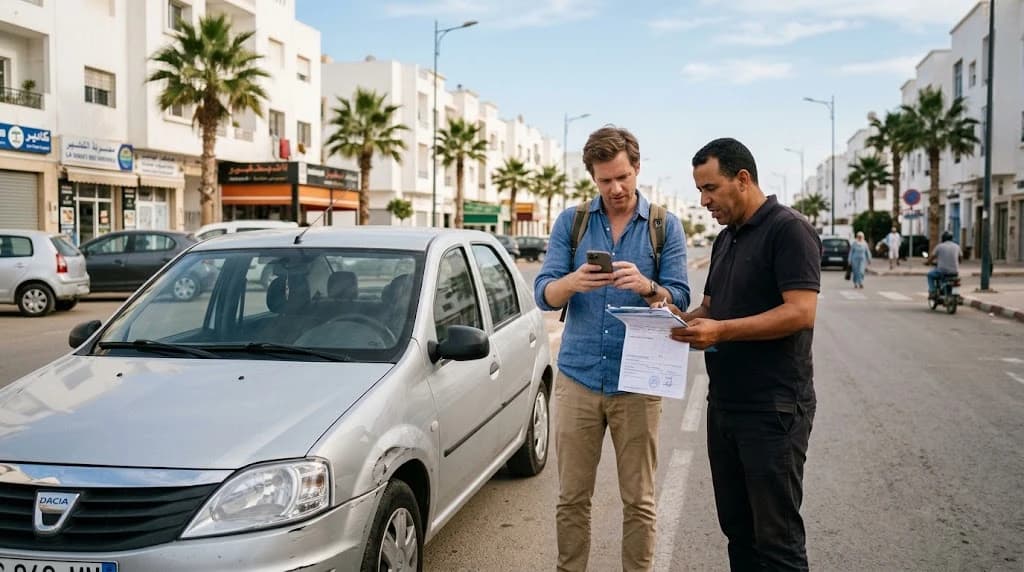
After a road accident in Agadir, two priorities meet: first any urgent medical needs, then preserving the evidence. In practice, that means keeping the accident report or police record, the insurance details, and the medical records, then identifying whether the harm is bodily, material (the vehicle and property) or both — because the compensation framework is not the same.
Moroccan law governs an accident that happens in Morocco, whoever is involved. This page focuses on the practical journey in Agadir; for the broader national framework as a foreign driver, see our guide on a car accident in Morocco as a foreigner.
This guide gives general information and does not replace medical advice or legal advice tailored to your case.
The first steps, one by one
- 1Attend to the injured first: call emergency services, and involve the authorities (police within the city, gendarmerie outside it) where there are injuries or disagreement.
- 2Have the right document drawn up: a joint accident report ('constat amiable') between drivers, or an official police/gendarmerie record where the authorities intervene.
- 3Record and keep the useful information: identities, insurers, vehicle registrations, and — if it is safe — photographs of the vehicles and the scene.
- 4See a doctor even without immediate pain, and keep every medical certificate and record.
- 5Notify the insurer within the deadline set by the policy, with the report and the available evidence.
- 6Do not sign anything you do not understand, and keep a copy of everything you hand over.
Bodily injury or vehicle damage: why the distinction matters
The distinction drives everything else. Bodily injury concerns harm to the person (injuries, incapacity, lasting effects, death); material damage concerns the vehicle and property. One accident may cause one, the other, or both.
Bodily injury to road-accident victims falls under a dedicated legal framework set by the 1984 dahir on compensating victims of accidents caused by motor vehicles. Material damage, by contrast, is handled under insurance and liability rules. Treating the two as one thing often means one side of the claim is overlooked.
How Moroccan motor insurance works
In Morocco, motor third-party liability insurance is compulsory: the Insurance Code requires that liability which may arise from damage caused to third parties by a vehicle be covered by insurance. It is this cover that, in principle, compensates injured third parties.
After the accident, the insurer assesses the file on the basis of the report, the expert assessments and the responsibilities. Do not confuse the compulsory third-party cover with optional guarantees (such as damage to your own vehicle), which depend on the policy taken out. As a foreign driver, whether foreign insurance or a foreign licence is recognised should be checked against Moroccan requirements rather than assumed.
How does compensation work?
Compensation is not automatic and does not follow a single figure: it depends on the circumstances of the accident, responsibility, the nature of the harm, the medical findings and the documents.
Bodily injury is valued under Dahir 1.84.177 of 2 October 1984, as amended by Law 70.24 (promulgated by Dahir 1.26.02 of 22 January 2026 and published in Bulletin Officiel no. 7478 of 29 January 2026). Under its Article 1 bis 2, compensation takes account of the share of liability borne by the person who caused the accident or the civilly liable person, except for funeral expenses, transport of the body and compensation for moral pain resulting from the victim's death. Deciding who is liable is a separate question from calculating the compensation under the dahir.
The reform applies to damage from accidents occurring from 29 January 2026; damage from accidents before that date remains outside it. A statutory table sets the bases for valuing bodily injury (taking into account, for example, age and the rate of incapacity), and Law 70.24 replaced that table.
In practice, bodily injury can only be valued once the victim's condition has stabilised (consolidation), after a medical assessment. No reliable estimate can be given in advance, and this guide offers no compensation 'calculator'. Our national guide on road-accident bodily-injury compensation sets out this framework in detail, beyond the Agadir context.
Medical expertise and vehicle expertise are not the same
The word 'expertise' covers two different things here. A medical assessment evaluates bodily injury: the nature of the injuries, temporary or permanent incapacity, and lasting effects, after consolidation. A vehicle assessment evaluates material damage: the damage, the repair cost, the value.
Any assessment informs the file but does not, by itself, create a right to compensation — it is one element of appraisal. In a dispute, the court may also order its own judicial expertise.
If the driver is uninsured or unidentified: the guarantee fund
Where the party responsible for the accident is unidentified, uninsured, or insolvent, the guarantee fund for traffic accidents (Fonds de garantie des accidents de la circulation) may cover, under conditions, the compensation of the victim's bodily injury.
This is neither automatic nor general: it mainly concerns bodily injury, requires proving the situation relied on (that the responsible party could not be identified, or was uninsured), and is subject to its own conditions and deadlines. It is therefore important to check eligibility and the applicable steps for the specific situation.
Deadlines and disagreement over compensation
Several distinct deadlines coexist and should not be confused: the claim must be declared to the insurer within the short period set by the policy; the insurer must communicate a compensation offer or a refusal within the period set by the dahir, and a failure to answer in time counts as a refusal; and the compensation claim and the court action are subject to time limits set by the 1984 dahir itself. Law 70.24 rewrote those claim and limitation provisions, but its Article 8 provides that the previous provisions continue to apply until the relevant implementing regulations take effect, so the applicable time limit should be checked against the regime in force for the particular accident and claim.
The starting points vary from case to case; rather than relying on a single number, it is better to check the deadline that applies exactly to your situation. If you disagree with the insurer's offer, it can be contested — first amicably, then, failing agreement, before the competent court.
Which documents should you keep?
- Accident: the joint accident report or police record, the parties' insurance details, vehicle registrations, photographs and available documents.
- Bodily injury: medical certificates, reports, prescriptions, treatment invoices, hospital documents and medical-expertise reports.
- Financial consequences: proof of the losses relied on, where legally relevant (time off work, loss of income).
- Vehicle damage: the vehicle-expert report, repair estimate or invoices, and correspondence with the insurer.
- Every notice and offer received, and a copy of anything signed or handed over.
Foreign or non-resident victims
Moroccan law governs an accident that happens in Morocco; your nationality does not change that basic point, though the practical side differs — the language, the Moroccan accident, insurance and medical documents, and any coordination with an insurer abroad.
The most common difficulty is leaving Morocco before the case is finished: the file can stay in Agadir. Before you travel, keep copies of every document — the report, the medical records, the insurance correspondence — because obtaining them again from abroad is harder.
Part of the follow-up — communication and document review — can be handled remotely, and a power of attorney may be used for certain acts where the law permits, though some steps may still require a presence. Our guide on finding a lawyer in Morocco explains how credentials and remote work generally function.
When can a lawyer be useful after a road accident in Agadir?
Many files are settled with the insurer, without going to court. A road accident lawyer in Agadir becomes useful above all where the file involves serious injuries, disputed responsibility, a disagreement over the insurer's offer, an uninsured or unidentified responsible party, or a fatal accident.
A lawyer can review the accident file and the reports, separate the bodily and material sides, assess the weight of a medical expertise, identify missing documents, examine the compensation offer, and handle a dispute with the insurer where appropriate. They can support an amicable process or represent the victim before the competent court where the law provides for it.
In a fatal accident, legal assistance may also concern eligible relatives and dependants. The aim is to help clarify the legal position, assess the available options and analyse the proposed compensation — with no guarantee of outcome: the lawyer's role is to analyse, advise and represent according to the facts, the documents and the applicable law.
Mistakes to avoid
- Leaving the scene without a report or without exchanging the necessary information.
- Skipping a prompt medical check, when some injuries do not appear immediately.
- Treating the bodily and material sides as one and neglecting one of them.
- Notifying the insurer after the deadline set by the policy.
- Accepting or signing a compensation offer before consolidation, or without understanding its basis.
- Assuming the guarantee fund pays automatically when the responsible party is uninsured, without checking the conditions.
Frequently Asked Questions
Does Moroccan law apply if I am a foreign visitor injured in Agadir?
Yes. An accident that happens in Morocco is governed by Moroccan law regardless of your nationality. What differs is the practical side — the documents, the language, and any coordination with an insurer abroad.
What is the difference between bodily injury and vehicle damage?
Bodily injury concerns harm to the person (injuries, incapacity, lasting effects, death) and falls under the 1984 dahir; vehicle damage concerns property and follows insurance and liability rules. One accident may cause one, the other, or both.
Is compensation automatic?
No. The right to compensation and its amount depend on the circumstances, responsibility, the nature of the harm, the medical findings and the documents. For bodily injury, valuation only happens after consolidation and a medical assessment.
What if the responsible driver is uninsured or unidentified?
The guarantee fund for traffic accidents may cover the victim's bodily injury, under conditions. It is not automatic: it requires proving the situation and meeting its own conditions and deadlines.
What if I return home before the case is finished?
The file can stay in Agadir. Keep copies of every document before leaving, as obtaining them again from abroad is harder. Part of the follow-up can be handled remotely, and a power of attorney may be used for certain acts where the law permits, though some steps may require a presence.
What is the deadline to act?
Several distinct deadlines exist: the declaration to the insurer (set by the policy), the insurer's offer (a legal timeframe), and the limitation period for the compensation action. The starting points vary, so check the deadline that applies exactly to your situation.
Does this guide replace tailored legal advice?
No. It provides general information; every accident depends on its own facts, documents and compensation framework.
Related guides
Car Accident in Morocco as a Foreigner: Insurance, Report and Legal Risks
This guide explains, informationally, the general steps to take after a car accident in Morocco as a foreign driver, from the accident report to compensation.
Lawyer in Morocco: How to Choose, Verify and Work With One
A practical, neutral guide to finding a lawyer in Morocco: what an 'avocat' does, how the profession and bars work, whether a lawyer can act anywhere in the country, how to choose and verify one, how to find English-speaking support, and how remote work with foreign or business clients typically works.
Note: this website provides general legal information and does not replace professional advice based on the facts and documents of each case.